
Updatable Ubuntu Server Live Installer

Joshua Powers
on 6 May 2020
This article originally appeared on Joshua Powers’ blog
The Ubuntu Server Live Installer, introduced with the release of Ubuntu 18.04 LTS (Bionic Beaver), provides a live Ubuntu Server environment along with a streamlined server installation experience. Building on guided installs for LVM, RAID, encrypted disks and advanced networking configuration (VLANs and bonds) the installer can refresh itself to the latest version during the live session. The update feature provides users with access to new features and bug fixes without needing to wait for the official point releases throughout the cycle. Let’s now have a look at how it works in practice.
After booting the live Ubuntu Server session on an Internet-connected server the installer will check and notify users if there is a newer version available. Users can either update the installer or skip the update.
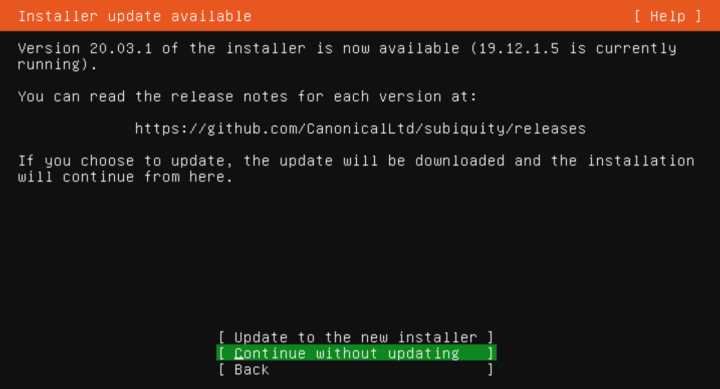
After selecting to update the installer, the user is shown the progress of the download and update. The install will resume after the update is complete.

The Updatable Ubuntu Server Live Installer is now available in both Ubuntu 18.04.3 LTS and Ubuntu 20.04 LTS. Users can download and try it here.
Talk to us today
Interested in running Ubuntu in your organisation?
Newsletter signup
Related posts
A decade of Ubuntu on IBM Z and IBM LinuxONE
This year we celebrate a decade of Ubuntu Server support on the s390x architecture: marking a long-standing collaboration between Canonical and IBM that began...
Ubuntu Summit 26.04: connected by open source
What an incredible experience! Ubuntu Summit 26.04 has officially drawn to a close, but the energy from our global community is still buzzing – in the...
Canonical announces optimized Ubuntu images for TPU virtual machines by Google Cloud
Canonical and Google Cloud announced the availability of certified Ubuntu images for Google’s Cloud TPU Virtual Machines.